Disc Root Crusher: Turning Stumps and Root Balls into Even Chips
Stumps and root balls are the part of a clearing job that a normal chipper cannot take. The pieces are too wide, too heavy and too irregular to pass a standard feed opening, so they usually end up burned or buried. A disc root crusher, also sold as a tree stump crusher or tree comprehensive crusher, is designed around that material. It takes whole stumps and root balls along with logs, branches, waste wood, weeds and bundled straw, and reduces them to chips of roughly 10 to 100 mm, with the finished size set by the screen fitted in the chamber.
A wide opening fed by machine, not by hand
Feed openings are built at 2.6 m, 3.2 m and 3.6 m depending on the model, large enough that the machine is normally loaded by grab or excavator rather than by hand. The hopper itself turns slowly while the rotor spins at speed, and teeth on the inner wall of the hopper push the load steadily toward the cutting rotor. Loose stump wood that would jam the narrow throat of a chipper moves through this arrangement in a continuous stream instead of stalling at the entrance.
Cutting, tearing and re-crushing inside the chamber
When the high-speed rotor meets the wood, the blades on the rotor cut and tear it apart in a first pass. Material that falls onto the screen below leaves the chamber if it is already small enough, while anything oversize is thrown back by the impact of the rotor and broken again, often two or three times, until it fits through the screen openings. Because a single piece may be worked several times before it exits, the chips come out noticeably more even than those produced by a single cut, which matters when the output is going to a boiler or a board line.
Fixed skid or mobile unit
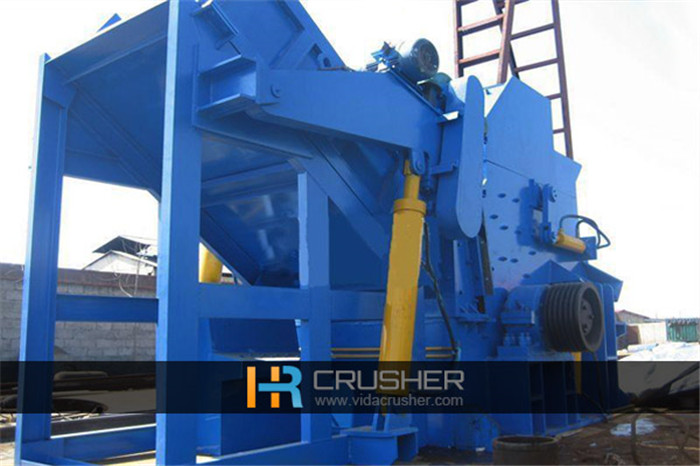
The fixed version is meant for a yard or plant where material is brought to the machine. The mobile version carries its own diesel power pack on a wheeled chassis, so it can be moved to the clearing site and work where the stumps are. Both use a heavy-duty reduction gearbox with gears strengthened for the shock loads of stump work, and circulating gear oil lubrication to keep the transmission cool. On the mobile unit a folding discharge conveyor loads chips straight into a truck, and the machine can be operated by remote control from up to 80 m away. A fixed HR2600 has a 2.6 m opening, runs on 110 kW main power, weighs about 11 t and measures 5.5 x 2.3 x 3.2 m; the mobile HR2600 weighs about 12 t and measures 7.5 x 2.5 x 3.5 m. Larger HR3200 and HR3600 units take 3.2 m and 3.6 m material.
Points to watch during operation
Several habits keep this class of machine out of trouble.
· Check the screws at the joints, and above all the screws holding the moving and fixed knives, before each shift.
· Feed evenly. Overloading the chamber is the usual cause of a stalled rotor.
· Never take off the feed hopper to feed directly, and never reach into the hopper by hand while the machine runs.
· When knives or screens are replaced, use the specified fasteners rather than ordinary ones.
· Stop at once if the machine starts to sound wrong, and clear the fault with the rotor stopped.
· Run the motor according to its nameplate; do not raise rotor speed to gain output.
Knives on the rotor, fixed knives in the mid-housing, V-belts, bearings and the crushing main shaft are the parts that wear, so they are the ones to keep in stock.
Product List
Metal Crusher
shredder machine
Stone Crusher
Plastic Crusher
Wood Crusher
E-Waste Scrap Shredder